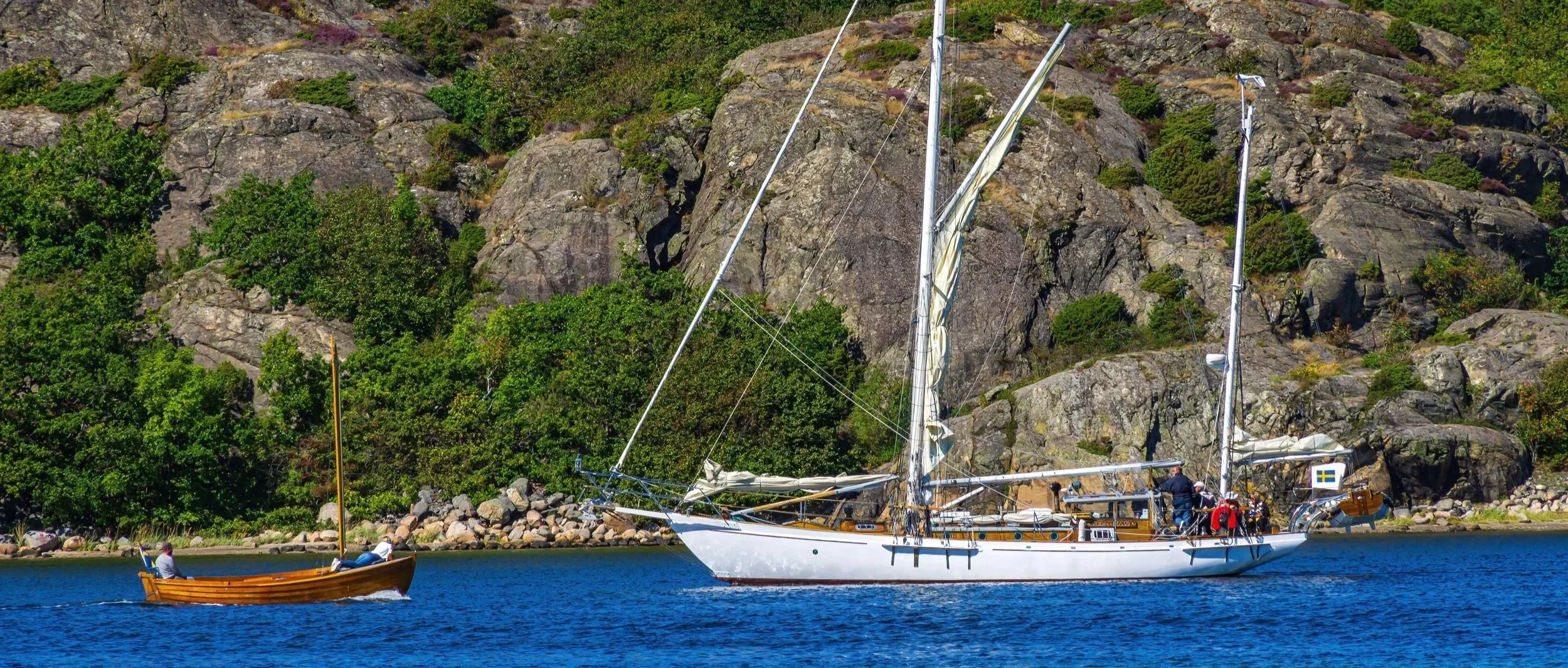
Knut Ulriksson | Koster Islands, Sweden | Licenced by Alamy Stock Photo
Advantages of a Traditional Hull Design for a Cruising Sailboat
by Charles F. Zimmermann
January 2026
Introduction
The purpose of this text is to provide a brief summary of the advantages of a traditional hull design, for a cruising sailboat. To begin this discussion we must address the question of what is a “cruising sailboat.” In the context of this text, this is a sailboat with
an overall length of at least 7 meters, but not more than 19 meters (not a daysailer, not a very large yacht, and not a sailing ship);
a single hull (not a catamaran);
sailing as the principal method of transportation (not a motor-sailer);
cruising as the principal objective of the design (not a racing sailboat);
sails that can be handled by two people (skipper and crew member) plus additional crew if the length is over 12 meters (not a boat designed for single-handed sailing);
a design suited to moderate weather conditions (normally Beaufort 0 to Beaufort 6, but occasionally Beaufort 7 or 8); not intended for long ocean voyages.
Of course, it is possible to use a traditional hull design to build a sailboat capable of sailing across the Pacific Ocean, or even to Antarctica. In this case, however, the hull and the mast and boom must be extremely strong and the owner must try to minimize the risk of being caught in extreme weather conditions (Beaufort 9 to Beaufort 12). To some degree the owner might try to avoid hurricanes and typhoons by relying on state-of-the-art weather forecasting models, state-of-the-art communications, and the possibility of helicopter or airplane rescue. However, that may all be wishful thinking. From a traditional perspective any sailboat intended for extreme weather conditions must be designed to carry a very large amount of safety equipment, reserve equipment, spare parts, and so on.
One idea that became popular in the 1970s and 1980s, with mass production of fiberglass hulls, was that a sailboat can be a “cruiser-racer,” i.e. a boat designed to provide all the comforts of cruising while achieving the speed required to win races. This is fundamentally misleading. A true racing boat has none of the comforts of a cruising boat, and in some cases the hull is so thin, the sails are so light, and the spars are so light that there is a chance that something will break in the middle of the race. A racing boat might even be designed with the idea that there will be a rescue team available during the race, and not far from the race course. Moreover, a true racing sailboat may be so expensive that the normal group of family and friends could not possibly afford to sail it.
If a yacht club or similar organization sets up a “regatta” with a mix of true racing sailboats and cruising sailboats, the racing sailboats will complete the course in less time. Therefore from a very simple perspective, one might say that racing sailboats always “win.” Of course, the race committee might try to implement rules according in which every boat has a chance to win the race. In very competitive racing, however, the standard practice is to separate sailboats by class and in effect, organize a separate race for each class.
Next, we must address the question of what is a “traditional hull design.” In the context of naval architecture this phrase is not very precise, but it is a useful concept from the viewpoint of a sailboat owner. A traditional hull design
has a keel which is an integral part of the hull (not a fin keel);
has a keel which runs most of the length of the boat below the waterline;
has a rudder which is attached to the keel;
has a very strong mast (or masts) fitted to the hull below the waterline;
is seaworthy enough to handle Beaufort 7 or 8 with a high degree of safety.
The keel may begin a few meters behind the bow, but it should extend all the way to the rudder. Of course, a large sailboat (with a length of 19 meters, for example) might be designed to handle very tough weather conditions, beyond Beaufort 8. In looking at traditional hull designs we may focus on the last 130 years, that is, 1896 to the present. Although boat designs evolved gradually, there is no need to look at a time frame longer than 130 years.
An excellent example of a traditional hull design is the Laurin Koster 32, which was designed by Arvid Laurin in 1963 and first built in 1964. The hull is fiberglass, but the design is similar to that of Koster boats built with wooden hulls. The design and construction of the Laurin Koster 32 is documented at https://www.laurinkoster32.com/history . In Sweden there is a Laurin Koster Society in which all of the different Laurin Koster designs are recognized (https://www.laurinkostersallskapet.se). Modern Koster designs are based on boatbuilding traditions on the west coast of Sweden, near the Koster Islands. According to Wikipedia, “The Koster boat has its origins in the decked driftnet boats that were mainly used in central and northern Bohuslän during the 19th century” (https://sv.wikipedia.org/wiki/Kosterb%C3%A5t ). Koster boats built in the 1960s and 1970s are lighter, faster, and better looking than the Koster boats of the early 20th century.
A traditional hull design might be used in a daysailer. It’s not just for cruising sailboats. Perhaps the best example is the Herreshoff 12 ½, which was designed in 1914 (see https://en.wikipedia.org/wiki/Herreshoff_12%C2%BD ). These boats are still being built (see https://www.capecodshipbuilding.com/fleet/index.php?boat=herreshoff ).
A beautiful example of a traditional hull design is the yacht “Wings of Grace” which was designed by Chuck Paine and built in 2006 by French & Webb, at Belfast, Maine, USA. The boat is an epoxy saturated cold molded wood ketch whose appearance is similar to boats designed by John Alden, a naval architect born in 1884 who was very well known in the 1930s and retired in 1955 (see https://en.wikipedia.org/wiki/John_Alden_(naval_architect). “Wings of Grace” is described at https://www.chuckpaine.com/replicas.html .
Construction: Composite/Wood
LOA: 55 ft
LOD: 50 ft
LWL: 39 ft 6 in
Draft: 6 ft
Beam: 3 ft 6 in
Displacement: 44,600 lbs
Sail Area: 1,421 sq ft
Power: 93 hp Yanmar
Fuel Capacity: 250 gallons
Water Capacity: 175 gallons
Ballast fixed: 18,000 lbs
Rig: Ketch w/ Carbon Fiber Spars
Source: https://www.frenchwebb.com/wings-of-grace
It may be noted that this yacht has a fairly large displacement, and a large ballast. This is not a racing sailboat. It is a long-distance cruising boat for the 21st century (see https://sailingmagazine.net/article-397-wings-of-grace.html).
Advantages of a traditional hull design, for a cruising sailboat
There are several advantages of a traditional hull design.
1. Ability to hold a course. The traditional hull tends to keep the boat on a steady course despite waves and wind gusts. The course might not be a constant with respect to compass heading; rather, it might be a constant with respect to wind direction. There isn’t a need for an autopilot to prevent the boat from being pushed to port or to starboard by the waves. If the sail area is centered just aft of the center of lateral resistance (below the waterline) it will not be necessary to move the tiller or the wheel constantly. An autopilot may be a nice addition to the boat, but for day sailing in normal weather it isn’t really necessary.
2. Minimal drift. As the boat holds its course, it will not drift sideways. The heading which you see on the compass is either the true heading, or very close to the true heading. If you see a lighthouse or a harbor on the horizon and you steer toward it, the boat will not drift away, unless it is pulled by currents. Of course it is very important to watch currents, including tidal currents. In some parts of the world the tides are quite modest, but there may be a significant current at the mouth of a river.
3. Stability. For the passengers, in normal weather the motion of the boat gives a nice feeling of stability. The boat doesn’t bounce around on the waves. The cockpit doesn’t bounce up and down. Although the boat might weigh a lot more than a modern fiberglass boat of the same length overall, that additional weight gives it a stability which makes sailing more enjoyable.
4. Ability to handle wind gusts. It is always important to reduce the sail area when there is a forecast of very strong wind gusts. However, if the boat is sailing under a mainsail and jib, and if the sail area is correct with regard to the average wind speed, the boat will stay on course and will not heel over excessively when a gust comes. In rare situations there could be a very strong gust which pushes the mast over, but even in that situation the traditional hull design is probably better than a modern design.
5. Ability to handle large waves. It is well known that a large cruising sailboat (60 feet in length) can handle large waves better than a small cruising sailboat (30 feet in length). However, the traditional hull design will make it easier to manage the waves, relative to a modern design with the same boat length overall. This becomes evident in weather conditions of Beaufort 5, 6, or 7. Stability in large waves is preferable when some of the people on the boat are not experienced sailors.
6. Greater stability when sailing downwind, in large waves. There is a possibility that when the boat is sailing before the wind, there may be very large waves which push the stern upward and may very quickly push the stern to port or to starboard. This is a bit dangerous, and from a safety viewpoint it is better to sail on a broad reach when the waves are high; it is better to tack downwind. The traditional hull design has a narrow stern which is not so easily pushed around by large waves. Therefore, the traditional hull design is safer. It should be noted that waves do not all move in exactly the same wave direction; there may occasionally be a large wave pushing the boat to starboard or to port even when the wind direction is extremely stable. The skipper must spend most of his time looking at the course ahead, and the sails, rather than looking at large waves astern of the boat. Of course, a racing sailboat on a downwind course might travel much faster than the waves; that capability is not very likely for a cruising sailboat. Putting on a lot of sail area for a downwind course is not a safe way to deal with the risk of high waves at the stern.
7. Easier boarding due to a lower deck height. Of course there are modern fiberglass boats in which the stern is very wide and is designed for easy boarding and therefore the boat is docked by setting the engine in reverse and putting the stern near the dock. That is not possible with a traditional hull design. However, boarding a boat on the deck or on the bowsprit is much easier when the height of the deck is low (closer to the water level). Many modern fiberglass boats have a very high deck.
8. Reduced risk of getting stuck on sand bank or very shallow area. With a traditional hull design, it should be possible to put the engine in reverse, and (if possible) shift weight to one side so that the mast is at an angle, to move off the sand bank or shallow area. Of course one should approach shallow waters very slowly, at 1 or 2 knots. It is best to enter and leave harbors where the harbor channels are wide and deep and well-marked. Even if some assistance is needed to get off the sand bank, the job will be quicker and simpler when the boat has a traditional hull design.
9. Reduced risk of getting caught in a fishing net. With a traditional hull design, a shallow fishing net cannot get caught on the keel, and there is a small chance that it will get caught on the rudder or the propeller, unless the engine is running. Of course one should always try to stay away from fishing nets, especially at night. If there is no wind at all and the boat is drifting, it might get caught in a net. If the engine is running it is always important to keep lines far away from the propeller.
10. Improved safety when moving around the cabin in rough weather. Perhaps this is not a significant advantage, but it should be noted. In a boat with an overall length of 30 to 40 feet, the cabin is narrower when there is a traditional hull design. There are railings to hold onto when the boat is sailing through large waves. For any boat, the motion in heavy waves is greatest at the bow and at the stern, and much less at the boat’s center of gravity. From a safety standpoint, however, when the weather is rough you don’t want to fall down and you don’t want to accidentally hit your head. You must be very careful, but the traditional hull design reduces that risk.
Disadvantages, for a cruising sailboat
In yacht design “nothing is free” and therefore in order to excel with regard to a particular objective, you always have to make some sort of tradeoff. Strictly speaking, that is not a “disadvantage.” For example, if you want to design a sailboat which meets the highest standards of quality and will last for a very long time, you must accept the fact that it will be a very expensive boat and there will not be a large market for it. The high price is not a “disadvantage” but a reflection of priorities in the design. One the other hand, if you want to design the cheapest possible sailboat at a certain overall length, you must sacrifice quality; it is unlikely that the boat will last longer than 20 years. The introduction of mass-produced fiberglass boats in the 1960s created an opportunity for boat manufacturers to sacrifice quality in order to lower the cost of the boat (although many manufacturers chose not to do that). The lower quality is not exactly a “disadvantage” but a reflection of the manufacturer’s desire to sell a large number of boats.
There are several disadvantages of a traditional hull design.
1. Less cabin space. A modern fiberglass sailboat may have a very wide stern, berths on both sides of the cockpit, a lot of headroom in the center of the main cabin, and greater headroom on the sides of the main cabin. The distance from the waterline to the deck could be much larger than in a traditional hull design. Against this standard, the boat with a traditional hull design looks cramped and much less comfortable. It typically has a smaller kitchen, less space for the toilet and sink, and no room at all for a hot shower. Of course, many of the modern fiberglass sailboats are over 40 feet in length and are therefore much larger than cruising sailboats built in the 1950s and 1960s. However, even a modern 35-foot boat has much more cabin space than a classic 35-foot boat with a traditional hull design.
2. Reduced speed, particularly in light winds. The traditional hull design results in higher displacement (weight) and a somewhat larger surface area of the hull below the waterline. In very light winds a boat with a traditional hull design moves slowly, and this can be very annoying.
3. Limited ability to steer in reverse. The traditional hull design allows the boat to move on a straight course in reverse, or on a course determined largely by the wind pushing the boat to one side when the engine is in reverse. Therefore if you really want to steer the boat, you need to put the engine in forward drive as soon as you can safely do so.
4. Much less convenience for swimming. The traditional hull design has a narrow stern, which means that if the boat is anchored (or drifting in a completely calm sea) the only way to go swimming is to use a ladder on the side of the boat (typically the starboard side) or a ladder on the stern. Of course, swimming is not a high priority when the water is cold; it might not be an option in Norway. Swimming should be a higher priority for summer cruises in the Mediterranean when the sun is shining, the deck is hot, and everyone would like to cool off.
5. Limited access from the stern. The traditional hull design has a narrow stern, and in some cases a rudder above the waterline and a tiller connected to the rudder, and therefore it is not very convenient to try to board the boat from the stern. A modern fiberglass boat typically is completely different. On a modern boat it may be very easy to board the boat from the stern.
6. Inability to ride the waves when sailing before the wind. The traditional hull design keeps the boat down in the water and does not allow the hull to rise up and “surf” the waves. This reduces the boat speed downwind. For a cruising boat, however, this should not be an important consideration.
7. (Possibly) higher cost. Today, a brand new cruising sailboat is rather expensive. Most sailboats today are mass-produced. It is a bit difficult to say what it would cost today to build a cruising sailboat with a traditional hull design. There is no question that it would be expensive to build a wooden boat today, with solid mahogany and oak and teak. Quite possibly it would be more expensive to build a sailboat with a traditional hull design, and mass-production.
Modern designs which provide seaworthiness
Today in North America and Europe, and in countries with developed economies, it is possible to use modern navigation systems and modern harbors to avoid the risks that were associated with sailing in shallow waters in the 1960s and 1970s. In addition, the development of catamaran construction since the 1970s has created the possibility to conduct long-distance cruising with a catamaran which can be safely anchored in shallow waters – for example, near a beach next to a beautiful island. If your number one priority is shallow-water sailing then you might choose a catamaran. If your priority is to sail from one harbor to the next, you will be interested in speed and comfort. As a result, the design of a single-hulled cruising sailboat intended for long-distance cruising from one harbor to another harbor has evolved significantly since 1980. It is no longer important for the boat to have a long keel. Rather, it is important to have a very strong hull and a strong bilge keel which is deep enough to provide the stability needed to sail through rough weather. The hull and keel must be designed to withstand large waves and strong winds. The deck plan will be similar to the deck plan of a traditional hull design. However, the profile of the hull below the waterline will be more modern.
One of the best examples of such a design is the Morris Yachts M52 (see https://morrisyachts.com/yachts/m52/ and in particular see the illustration of the hull profile at “Specs”). At the website for the M52 there is a statement. You are onboard one of the most seaworthy boats in the world. Setting the industry standard, Morris Yachts’ level of engineering, fit and finish sets the benchmark by which other builders measure themselves. Morris Yachts are built in Maine, USA. It is reasonable to assume that this statement is completely true, and it is not simply advertising. Of course, a Morris Yachts M52 is not cheap; it will probably cost more than $1.4 million. Nevertheless, some sailboat owners are willing to pay for seaworthiness in the design and construction of a brand new boat.

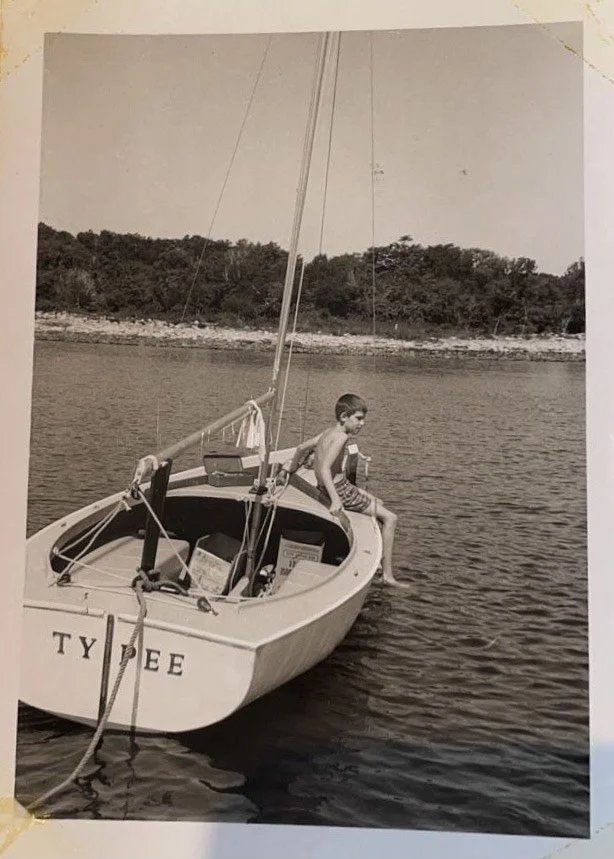
Charles was born in 1949 in Philadelphia, Pennsylvania and learned to sail in Narragansett Bay, Rhode Island. He began sailing in 1957 and had the opportunity to sail on both fiberglass boats and wooden boats in the 1950s and 1960s. He has a bit of experience in coastal cruising in New England, in the Baltic Sea, in the Markermeer and IJsselmeer, and in the southern coast of England. He moved to Latvia in 1995 and purchased a Koster K38 in Sweden in 2010. Since that time he has had a great deal of experience in the maintenance and modernization of the K38.
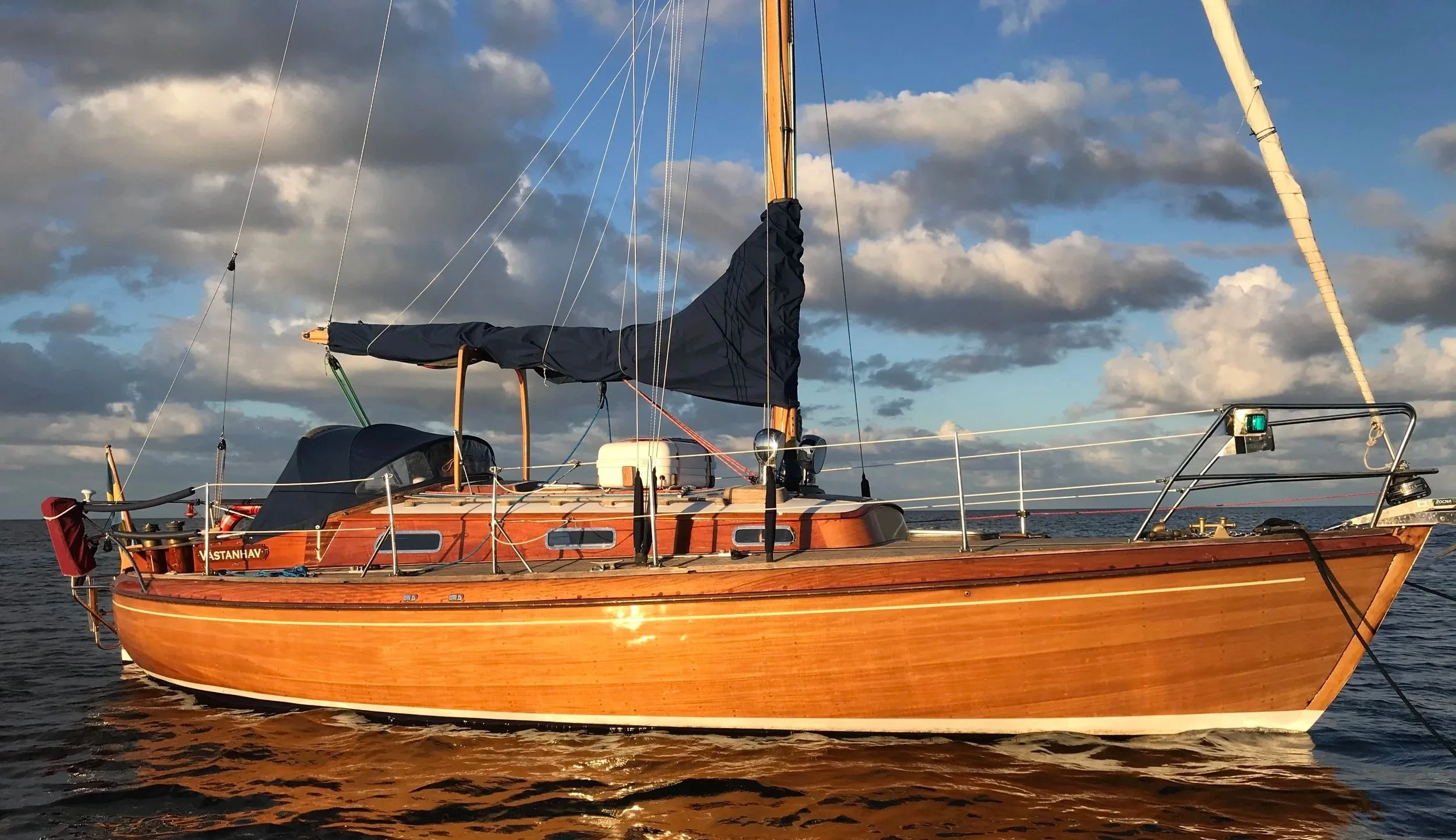
Charles' current boat is this beautiful “Västanhav,” a Koster K38 built by Thore Larsson in 1979. Length 8.9 m, width 2.8 m, draft 1.65 m, displacement 4.7 t.
www.laurinkoster32.com would like to express its sincere thanks for providing this article.