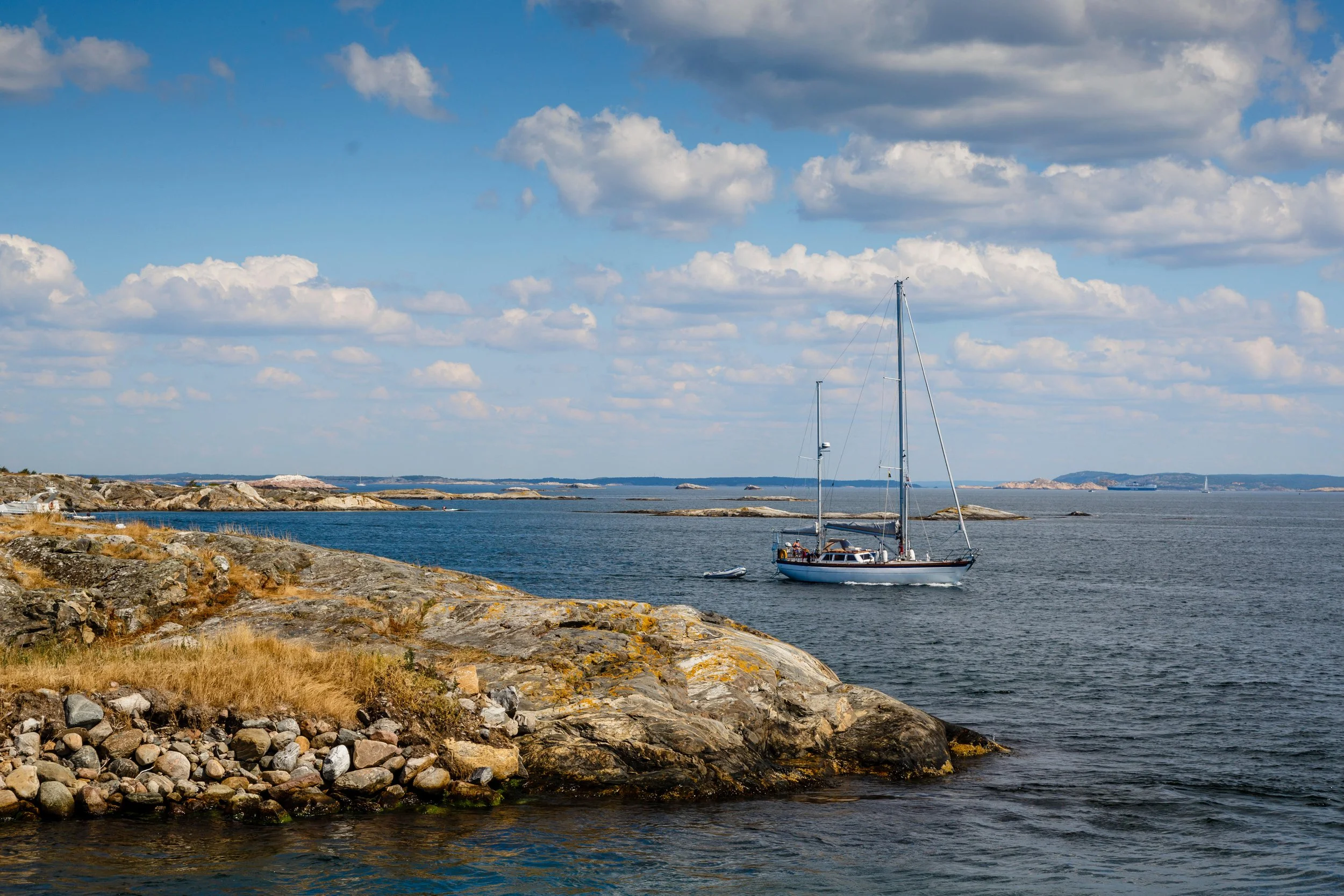
Robert Harding | Koster Islands, Sweden | Licenced by Alamy Stock Photo
The History …
-
Arvid Laurin was born on October 3, 1901 in Lysekil on the Swedish west coast, where his father was the owner and manager of “Skandiaverken”, which manufactured heavy internal combustion engines.
He trained as a civil engineer at Chalmers University in Gothenburg and graduated with top marks. He was able to put his newly acquired knowledge and theories to the test at his father's factory, where he designed new engines.
During his military service in the Swedish navy, he learned to fly and studied aerodynamics.
In the 1930s, he was asked to help improve sound recording in films and developed improved electrical equipment in this area. He was hired by Bolinder-Munktell and soon after was appointed chief designer for their huge diesel engines.
He started sailing at the age of 13 and got his first sailing boat. He changed the design of the boat and improved the cut of the sails. He did the same for other boats in the “regatta fleet”, whose speed he was able to increase. His first design commission soon followed, a modest fishing boat. He was asked to design a lottery boat, which was popular with yacht clubs at the time. This had to conform to the “Koster rules” and the resulting boat was so much faster than other Kosters that orders for more Kosters started rolling in.
In the 1930s, he started racing in starboats and became helmsman champion in his class. In 1936, he was named to the Swedish Olympic sailing team and returned with a silver medal. If he hadn't had bad luck in the last race, it would have been gold.
From the Stars, he moved up to the 5-meter class, where he also became a top helmsman. Feeling that he could design a faster model, he created Gullmar III, which was nicknamed “The Box”. More designs followed, and Swedish sailors half-jokingly complained that he had “ruined” the class, because to have a chance of winning, a design by Laurin was essential. His design won gold at the 1952 Olympic Games in Helsinki and four years later in Melbourne
He started designing in the 6-meter class and won the Gold Cup Regatta in Sandhamn with the “Trickson VI”, which he built for himself. He next became interested in the new 5.5-meter class and the success of his yachts attracted orders from all over the world. Many of these yachts won world championships and Olympic medals.
In time, he and his fellow racing captains married and started families. They needed fast, seaworthy cruising boats and Arvid began to design his “modern” Koster boats. Later, Arvid Laurin explained his goals when building his Kosters: “I wanted a seaworthy and strong boat that didn't look like a cigar box at the same time. By using the Waldeck - which happened sometime in the forties - the strength was further increased.
Most Koster boats were built by the Rosättra Varv (shipyard) in Sweden.
Initially, these were designed specifically for the owner's requirements and were “one-offs”. This led to the successful L28, which was first built from wood and later from fiberglass. In 1963, he designed the first Koster boat specifically for fiberglass construction and became known as the L32.
He later added an L38, which was produced in limited numbers.
Laurin designed an experimental boat for his old friends Carl and Ulla Frostell, which they called “Carousel”, a combination of the names. This was followed by another test boat for himself, called “Gullmar VII”, which later belonged to the Frostells. With transoms, they were no Kosters, but very ingenious, fast and seaworthy.
Before his death in 1998, Arvid entrusted all his designs to Carl Frostell, who ensured that they were kept in the “Sjohistoriska Museets Samling” (Maritime Museum). They can be viewed there.
Described by many as a “Swedish genius”, his far-reaching, inquiring mind, which encompassed many areas, remained active until the end. His contribution to sailing, particularly in Sweden, was a force to be reckoned with, as evidenced by his enormous output of brilliant designs.
Source: https://classicyachtinfo.com/designer/arvid-laurin/
Translation from German with DeepL.com
-
Background
It all began at Malmö FlygindustrI (MFI), Southern Sweden, which was started by Frans Henrik Kockum as part of the Trelleborg Group (Trelleborg Rubber). Beside designing and building light aircraft, MFI was experienced in building 25 and 29 feet double ended work wessels.
In 1962, MFI had a slow period in the aircraft production and it was decided to expand the business by playing an active role in an emerging market for glass fibre sailing yachts.
In their search for a suitable plug, they chose "Casella II" an Arvid Laurin design - which had participated in the Transatlantic Race from Bermuda to Gothenburg n 1960, arranged to celebrate the centenary of the foundation of GKSS (Gothenburg's Royal Yacht Club). Her owner - Yngve Cassel - was approached and for a fee he agreed to have his boat used as a full-scale mould
Somehow Arvid Laurin got wind of this plan and pointed out to MFI, that it was not recommendable to build a glass fibre version of an old design, when he could draw them a better and faster one, especially designed to take advantage of the flexibility of glass fibre construction. MFI agreed and Arvid Laurin set out to do something quite new to him, drawing a 32' boat that would not be built of wood but in a much more flexible material allowing curvatures that previously had been impossible.
Source: https://web.archive.org/web/20200925122522/http:/laurinkoster.dk/index.HTM
-
The drawings were made in Arvid Laurin's home in Saltsjöbaden in November 1962.The first drawing was made (on the left), on which many of the first orders was sold. It was, however changed (fig. 2) to make more room in the cockpit.
During In the first part of 1963, all the construction and modelling work were done from the final drawing (right) and in October was the final plug approved.
With respect to the deck layout and interior, MFI received qualified assistance from a local group of early L32 buyers, who had decided to do this work by themselves.
The first L32 - "Tjoo-Hoo" was launched in April 1964 - unfortunately not in time to be exhibited in the Hamburg Boat Show in 1963. A scaled model (ref. left margin) was produced and exhibited in stead. People were so impressed, that MFI took enough orders to keep the yard busy for a year and 75 contracts were signed, even before Tjo-Hoo was launched.
Originally "Tjoo Hoo" had sail number 663, but for reasons only known by few, it was exchanged with "Eva's" number 666, which was subsequently used in all drawings in MFI's marketing material and on this site. The whereabouts of "Tjoo Hoo" today is unknown to the Webmaster and information would be appreciated.
It has always been claimed that Malmö Flygindustri altered Arvid Laurin's original drawings:
Firstly, there was no lead inlay in the iron keel, although the design meant to have 585 kg in the front of the keel, making the keel heavier and moving the weight balance forward when the boat is heeling over.
Secondly, The chain plates were moved to the outside of the hull, although they were meant to be in the deck just inside foot rail, to get the Genoa closer midships.
Thirdly, it has a masthead rig, although it was designed with a 11/12 rig with a taller mast (14,5 m)and shorter boom, all together moving the sail centre forward.
These "small" differences could give a boat, that does not luff so much to windward in strong winds. Two L32s have actually be rigged following the original ideas of Arvid Laurin.
Source: https://web.archive.org/web/20200925122522/http:/laurinkoster.dk/index.HTM
-
MFI's idea was to produce only the hull including deck and a mounted keel and then ship it to the buyer (or agent). Then the buyer (or agent) would complete the work according to his own ideas, either by doing it himself or by arrangement with a yard. MFI also provided an extensive handbook for the "Do it yourself" people with detailed information about how to go about building the interior fittings.
The L32 was produced by MFI until 1968, with a total production of 111:
The first model ("The Classic" - MK1 ) - the short cabin version - was produced in 2 series of 50
It is not confirmed, but it has been said that the first 60 boats were made with Divinysell as the Sandwich Core in hull and deck, whereas the last boats had Balsa as Core material.
In the later part of 1965, an additional hull and deck moulds were produced for the MK2 (long cabin). These were slightly different to the MK1 moulds and could, consequently, not be interchanged in production. Only 11 MK2' were produced.
An estimate of the Build numbers for the total production is as follows:
1964 no. 1 - 50
1965 no. 51 - 90
1966 no. 91 - 98
1967 no. 99 - 104 and
1968 no. 105 - 111
Since the major product of the MFIs was the development of aircrafts, the company was sold to SAAB in March 1968.
Source: https://web.archive.org/web/20200925122522/http:/laurinkoster.dk/index.HTM
-
1969 the plugs were transferred to "Karlskrona Varvet", a shipyard with a long history of building navy vessels. Only one Demo boat was built here. The 2 other boats claimed to have been built here are assumed to be remains of the Malmö production....
However, during 1971-73, the shipyard let out the plugs to individual projects, out of which came a total of 16 with a split of 8 of each model.
6 of the MK2s were built in Bror Janson's Yard in Fjällbacka on the Swedish West coast under the initiative of Göte Windeman, Jan Karlsson and Jan Steenberg, who was the "Purchasing Manager" and was activily involved in transporting the "MK2 mould" from Karlskrona Varvet and back.
It was during the period of 1971-73, that an extra "MK2 mould" was made, which was used for a Norwegian production of 6 before it was destroyed. These are the only L32s, which were not build in sandwich
Source: https://web.archive.org/web/20200925122522/http:/laurinkoster.dk/index.HTM
-
In 1973, Karlskrona Varvet sold the MK1 mould to a newly started company "Berg Marin AB". The owners - Benny Carlson and Rolf Palmquist - had owned "Bergåsa Bilvård" since 1966. Beside Auto repair, etc. they let out moulds for DIY production of multiple boats upto 26 feet. They sold the company and brought the many moulds together with the L32 MK1 and the OC35 (another MFI production) into Berg Marin.
The production only reached a number of 12 boats (2 in1973, 8 in 1974 and 2 in 1975) when the plug was at its last leg. KR S 5459 "Annelie" was the last one to be built in it. Before being destroyed, however, it was used as mould for the MK3 plug.
Basically it was a MK1, which had been modified on the following points:
7 cm higher freeboard
The 1 m higher mast was moved 20 cm forward and the boom shortened
The weight of the keel was increased by 425 kg
The Chain plates moved to the top of the Whale Deck
Changed cockpit lay-out
In addition, many of the boats have a bowsprit of 0,8 m
All boats were delivered with mounted rudder, keel, Chain plates , etc and sometimes also the engine. With the exception of the 2 last MK3s (and maybe "Anneli"(KR-S 5459) and "Leoni" (KR-S762) from the 12 MK1s) the sandwich core was 3/4" balsa in hull and deck, whereas the cabin roof was 1" and the sides 3/8".
Berg Marin used a production form, which entailed, that the buyer participated in the production in about 14 days, supervised by Sven "Nisse" Nilsson. This system was approved by "Norske Veritas", which after a control issued a certificate on each delivery. Apart from 1 boat, the interior was always made by the owners themselves or another shipyard.
In total 33 MK3 were produced, before the production was laid down in 1985 after the 2 Berg Marin owners completed a boat for each one of them.
Source: https://web.archive.org/web/20200925122522/http:/laurinkoster.dk/index.HTM
-
When Karlskrona Varvet sold their plugs in 1973, the MK2 one was bought by a group of 10 L32 enthusiasts in Göteborg, with Lars G Larson as Primus Inter Pares. The objective was initially to make a boat for each of the members of the group and keep the cost as low as possible. This was achieved through volume purchase.
They found a production site in Lerum, just outside Göteborg, and the production began. The building process was in essence, that the owners were doing the hull himself assisted by the owners of the boats before and after him in the production line.Some few were made with Divinysell as the Sandwich Core in hull and deck, but the majority had Balsa as Core material.
The word of this production got around and soon came requests for boats from outside of the group. To honour this new demand, the new company was founded to manage the production.After having built 30, the mould was moved to Trio Marin, Kungälv in 1975, where Sony Baldestam was supervising and coordinating the production of additional 19 boats after the same production pattern as in Lerum. All the boats of this series had Divinysell both in hull and deck
After completion of this series of boats in 1980, the mould was dormant for about 8 years before a small production of 4 boats took place in Torslanda in 1988-89. These boats were the last to ever use this mould and the latest L32 produced.
Via the Internet, the plug was later offered free of charge to anyone who would remove it from its storage, but in lack of positive response it was finally destroyed some time during year 2000.Source: https://web.archive.org/web/20200925122522/http:/laurinkoster.dk/index.HTM
More Stuff …
-
The Term "Koster Boat" stems from the type of fishing boats build on the Koster Islands west of Strömstad on the Swedish west coast.
The original fishing boats ("Allmoge båtar") were about 10-12 meters in length, and were relatively broad and round, but had at the same time a deep and sharp underwater body, which made them very seaworthy and well sailing. They were clinker built with Gaff rig and a bowsprit.
Later it was "copied" to be a Racing & Recreational boat and was fitted with Bermuda Rig and then called "Modern Koster".
The popularity of the Modern Kosters rose drastically and in 1930 the "Swedish Kosterbåt Förbund (SKBF) was founded. In 1934 they launched an uniform rules for Koster Sailboats, giving following classes: K20 , K22 , K25, K32 , K38 , and K45 . K stands for "kosterbåt" and the numbers indicate the minimum of square meters of sail the boat need to have. Up to 20% larger sail area is allowed, so for instant a K32 can have between 32 and 38,4 m2 sail area. This means, that the measurements of a boat still plays a role. To which extend, is not known to this site, but the actual class will be determined by SKBF when a Koster Boat is measured. SKBF also made a unique Koster Class - K6 - the first boat of which was built in 1944. It has a LOA of 6.25 m, a Beam of 2.25 and a sail area of 18 m2.In 1966, SKBF announced a design competition under the "Koster Rule" for K25. This was won by Lars-Olof Norlin with a construction in fibreglass reinforced polyester - Allegro 27, thus confirming fibreglass to be a material to be reckoned with for future boat building.
The first comprehensive fibreglass production, however, started already in 1964 when the first Laurin 32 saw the day of light in Malmö Flyg Industry.
The majority of Laurin Kosters follows the Koster Rule, but differs from the original form, by smaller beam and with a "Whaledeck” (valdäck) , i.e. the transition between the side and the deck is rounded.
Examples of Koster Boats: Havs- and Storfidra - Laurin 28, 31 & 32 - Allegro 27, 30 & 33 - Vagabond 31
Koster Boats Constructors: Arvid Laurin - Georg Ström - Hjalmar Johansson - Johan H. Seldén - Knud H. Reimers - Lars-Olof Norlin
Famous Koster Boat Builders: The name most knowledgeable of all builders in Bohuslän in the mid -1800s was Thomas Kile from South Koster.The boat building trade were often handed down through families, so Tomas was followed by his nephew - Hans Henriksson - and his son - Karl Hansson - both from South Koster.
Another renowned boat builders from Koster was Anders Persson in Brevik.
More Builders on the Swedish West Coast were Carl Stjern from Galtö and Johan Harald Seldén from Buvenäs, Orust (1880 - 1916).
Later the building of Kosters moved to the Swedish East Coast, where "Rosättra Varvet" in Roslagen, North of Stockholm is renown for building a huge number of - especially Laurin - Kosters.
Source: https://web.archive.org/web/20200925122522/http:/laurinkoster.dk/index.HTM
-
In cooperation with Nisse Dunér of the SKBF, the "Koster Rule" is now translated into English as follows:
The koster boat is a double-ender, i.e the stern is sharp or rounded with an external hinged rudder
The stem must be straight or inclined a max. 60 degrees
The construction of wooden keel, stem, stern post, frames etc. has to be strong
The ballast keel shall be of Iron and run almost the full length of the wooden keel
The profile of the lines of the underwater body shall be straight or moderately convex (not concave)
The length of the mast must not be more than 3 times the length of the main boom
This site only allows few exceptions from the above rule i.e.
A) The L38, which does not comply with rule 5 and
B) Few boats with Lead Keel (Rule 4).
We allow these exceptions as these boats in other ways follow Arvin Laurin's "Koster interpretation" and therefore seem to be "natural members of the Laurin Koster Family".
This, however, must not be taken as an attempt to argue the validity of the Koster Rule.
Source: https://web.archive.org/web/20200925122522/http:/laurinkoster.dk/index.HTM
-
In the homeland of the Laurin Koster 32, Sweden, there is a small but lively association of Laurin Koster fans, the “Laurinkostersällskapet.”
-